ADHD Assessment Results for School Accommodations: Using IEP & 504 Plans
When your child struggles with focus in the classroom, seeing their potential go unrecognized can be heartbreaking. You've noticed the challenges with homework, organization, or following instructions. But knowing where to turn for help can feel overwhelming. How can you get your child the support they need to thrive at school?
An ADHD assessment is a powerful first step. The results provide valuable documentation that helps schools understand your child's unique needs and implement the right support. Many parents, however, are unsure how to use these screening results to advocate for their children. Taking an initial online ADHD assessment can give you the clear data you need to start this important conversation.
This guide will show you exactly how to use ADHD assessment results to get the support your child needs to thrive at school. We will cover Individualized Education Programs (IEPs), 504 plans, and how to communicate effectively with your child's school.

Understanding ADHD Assessment Results for School Needs
Before you meet with the school, it's crucial to understand what your child's assessment results mean. These reports are more than just numbers; they tell a story about your child's specific strengths and challenges in an academic setting. Translating this data into actionable requests is key to getting effective support.
How ADHD Assessment Scores Translate to Classroom Challenges
ADHD assessments, like the Vanderbilt or ASRS scales, often break down symptoms into categories such as inattention and hyperactivity-impulsivity. A high score in inattention might explain why your child has trouble finishing classwork, frequently loses their supplies, or seems to daydream during lectures.
On the other hand, a high score in hyperactivity-impulsivity could relate to behaviors like fidgeting, interrupting the teacher, or acting without thinking. Connecting these scores to real-world classroom examples helps educators see the direct impact of ADHD on your child's learning experience. For instance, you can explain that a specific score reflects their difficulty waiting their turn in line or staying seated during quiet work time.
Key Documentation Needed for School Accommodations
Schools need clear and credible documentation to justify providing accommodations. While a formal diagnosis from a healthcare professional is often required for an IEP or 504 plan, an initial assessment report is an excellent starting point.
Your report should clearly outline the observed behaviors and symptom scores. If you use a tool like ours, the AI-powered personalized insights can be particularly helpful. They offer detailed explanations of how your child's attention patterns might affect their school performance, giving you specific language to use in your requests. Bring a printed copy of the assessment summary to your meetings, as having the physical document can be very helpful during discussions.

The Difference Between Screening Results and Formal Diagnosis
It is essential to understand the distinction between a screening tool and a formal diagnosis. An online ADHD assessment is a screening tool. It identifies patterns and traits consistent with ADHD, providing a strong basis for further action. It is not a medical diagnosis.
A formal diagnosis must be made by a qualified healthcare professional, such as a pediatrician, psychologist, or psychiatrist. However, presenting the school with comprehensive screening results shows you have done your due diligence. It often prompts the school to conduct its own evaluation, moving the process forward much more quickly. You can present your assessment results as the first step in your journey to seek clarity.
Navigating the IEP Process with ADHD Assessment Results
If your child's ADHD significantly impacts their ability to learn and requires specialized instruction, an Individualized Education Program (IEP) may be necessary. Your assessment results are a critical piece of evidence in this process.
Step-by-Step Guide to Requesting an IEP Evaluation
The process begins with a formal written request for an evaluation. Submit a letter or email to the school's principal or special education director. In your request, state that you are concerned about your child's academic progress and believe they may have a disability that requires special education services.
Mention that you have preliminary data from an ADHD assessment that indicates specific challenges. This shows you have a concrete reason for your request. After you submit the letter, the school has a specific timeline (which varies by state) to respond and, if they agree, to complete the evaluation.
Writing Effective Parent Concerns Statements for IEP Meetings
During the IEP process, you will be asked to provide a "parent concerns" statement. This is your opportunity to formally share your observations. Use the findings from your ADHD assessment to structure your statement.
Instead of saying, "My child can't focus," you can say, "As noted in their assessment, my child shows significant signs of inattention, which we see in the classroom when they struggle to complete independent work and frequently miss instructions." This ties your personal observations to objective data, making your concerns more powerful.
Sample IEP Goals for ADHD-Related Challenges
IEP goals must be specific, measurable, achievable, relevant, and time-bound (SMART). Your assessment results can help you suggest relevant goals.
- For Inattention: "By the end of the semester, with the use of a visual checklist, [Child's Name] will independently pack their backpack with all necessary homework and supplies on 4 out of 5 days."
- For Hyperactivity/Impulsivity: "During group discussions, [Child's Name] will use a non-verbal cue to signal they want to speak, reducing interruptions to an average of 1 per discussion over a 2-week period."
- For Organization: "Given a multi-step project, [Child's Name] will break it down into smaller parts using a graphic organizer and meet 80% of the mini-deadlines with one teacher check-in per week."
Working with School Psychologists Using Your Assessment Data
Your assessment report is an excellent tool for collaborating with the school psychologist. They are trained to interpret this kind of data. Share the report with them and ask for their professional opinion on how the findings relate to your child's educational needs. This collaborative approach shows you respect their expertise and want to work as a team to support your child.
Securing 504 Plan Accommodations Based on ADHD Assessment
If your child does not require specialized instruction but needs accommodations to access the general education curriculum, a 504 plan is often the appropriate path. A 504 plan is designed to level the playing field for students with disabilities.
When a 504 Plan Might Be Better Than an IEP for ADHD
A 504 plan is generally a good fit for a student with ADHD who is performing at grade level but requires support to manage their symptoms. For example, a bright student who understands the material but can't finish tests in the allotted time due to inattention would be a prime candidate for a 504 plan. An IEP is for students whose disability adversely affects their educational performance to the point they need specially designed instruction.
Common 504 Accommodations for ADHD Students
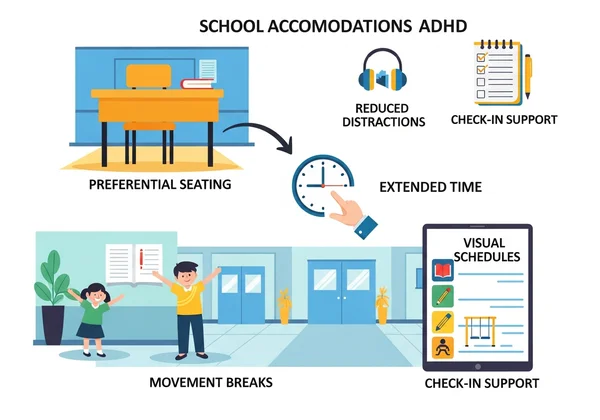
Accommodations are not about giving an unfair advantage; they are about providing equal access. Your ADHD assessment can help justify requests for specific accommodations. Common examples include:
-
Preferential seating (e.g., near the teacher, away from distractions)
-
Extended time on tests and assignments
-
Breaking down large assignments into smaller, manageable parts
-
Providing written instructions in addition to verbal ones
-
Allowing for movement breaks or use of a fidget tool
-
Use of a planner with teacher check-ins
Sample 504 Plan Language Using Assessment Findings
When proposing accommodations, link them directly to your assessment results. For example: "Based on assessment scores indicating significant challenges with inattention, we request extended time on tests to allow [Child's Name] to process questions fully and check their work." Another example: "To address hyperactivity noted in the assessment, we request planned movement breaks to help [Child's Name] maintain focus during long instructional periods."
Rights and Responsibilities Under Section 504
As a parent, you have the right to request a 504 evaluation, participate in all meetings, and appeal any decisions you disagree with. The school is responsible for identifying and evaluating students who may need support, and for implementing the agreed-upon plan. Understanding your rights empowers you to be a strong and effective advocate for your child.
Communicating with Schools About ADHD Assessment Results
Having the data is one thing; communicating it effectively is another. A collaborative, informed, and persistent approach will yield the best results for your child. It can be helpful to get a clear picture of your child's needs with an initial screening before you begin these conversations.
Parent-Educator Communication Scripts for ADHD Accommodations
When speaking with teachers, lead with a spirit of partnership.
- Opening a conversation: "I wanted to share some insights from a recent ADHD assessment we completed for [Child's Name]. I'm hoping we can work together to find some strategies that will help them in your classroom."
- Requesting a specific strategy: "The assessment highlighted challenges with working memory. Would it be possible to provide a written copy of the homework instructions to help them remember what to do?"
- Following up: "I wanted to check in and see if the preferential seating we discussed seems to be helping [Child's Name] with their focus. Is there anything you're noticing?"
Addressing School Staff Misconceptions About ADHD
Unfortunately, some educators may still have outdated views on ADHD, seeing it as a lack of discipline or effort. Be prepared to educate them calmly and respectfully. Use your assessment report as an objective tool.
You can say, "I understand why it might look like a lack of effort, but the assessment shows this is related to neurological differences in executive function. The challenge isn't with 'wanting to' but with 'being able to' without the right support."
Preparing for School Meetings with Your Assessment Report
Go into every meeting prepared. Create a binder with a copy of your assessment report, your written request for evaluation, a list of your observations, and your proposed accommodations or goals. Highlight key sections of the report you want to discuss. Being organized shows you are serious and helps keep the meeting focused and productive.

When Schools Resist Accommodation Requests
If the school pushes back, don't give up. First, ask them to explain their reasoning in writing. Politely ask what specific information or documentation they would need to approve the request. Sometimes, the issue is a lack of understanding, which can be solved with more information. If you continue to face resistance, you can seek help from a parent advocacy group or a special education lawyer.
Your Next Steps in Getting School Support for ADHD
Your child's ADHD assessment results can help you unlock the educational support they need to succeed. These results provide the objective data necessary to advocate effectively for your child's needs in school.
While screening results provide helpful insights, it's important to discuss them with a healthcare professional to get a formal diagnosis. Taking the first step with an assessment empowers you with the documentation you need to begin constructive conversations with your child's school.
Are you ready to gain clarity and start advocating for your child? Start your online ADHD assessment today and receive clear, personalized results that you can use as a foundation for school discussions.
Disclaimer: This article is for informational purposes only and does not constitute medical advice. It is not a substitute for professional medical advice, diagnosis, or treatment. Always seek the advice of your physician or other qualified health provider with any questions you may have regarding a medical condition. The results of our online screening tool should be used as a starting point for discussions with qualified healthcare professionals and school officials.
Frequently Asked Questions About ADHD Assessments for School
Can an online ADHD assessment be used for school accommodations?
An online ADHD assessment, like the one offered on our site, is an excellent first step. It provides structured data and personalized insights that you can use to start a conversation with the school and request a formal evaluation. While schools typically require a diagnosis from a healthcare provider for an official plan, these screening results are powerful preliminary evidence.
What's the difference between an IEP and a 504 plan for ADHD?
An IEP (Individualized Education Program) is for students whose ADHD adversely affects their learning to the point they need specialized instruction. A 504 plan is for students who can learn in the general education classroom but need accommodations (like extended time) to access the curriculum equally. The results from an ADHD screening can help determine which path might be more appropriate.
How long does the school accommodation process typically take?
The timeline varies by state and district, but federal law sets deadlines. Once you submit a written request for an evaluation, the school usually has 60 days to complete it. From there, if the child is found eligible, the team has another 30 days to develop the IEP or 504 plan.
What if my child's school doesn't accept our assessment results?
If a school is hesitant to accept your online assessment results, frame them as the reason for your request for a formal school-based evaluation. Say, "These results have raised significant concerns, and we are now formally requesting that the school conduct its own evaluation to determine eligibility for services." The report still serves its purpose by initiating the official process.
Can I request specific accommodations based on my child's assessment scores?
Absolutely. This is one of the most effective ways to use your assessment results. If the report shows a high score for inattention, you can directly request accommodations like preferential seating or written instructions. Linking your request to a specific data point in the assessment makes it much more compelling and harder for the school to deny.