ADHD Assessments Across Cultures: Why Diversity Matters in Symptom Recognition
Have you ever wondered why ADHD symptoms seem different across various cultures? Perhaps your assessment experience didn't quite match what you read online. Many people find that standard descriptions of "hyperactivity" or "unfocus" fail to capture their specific life experiences. This happens because ADHD is not a one-size-fits-all condition. It is deeply influenced by your cultural background and social environment.
When discussing Attention Deficit Hyperactivity Disorder (ADHD), we usually rely on Western clinical standards. However, the way a person expresses these traits varies wildly across the globe. How your family or community views these behaviors also changes based on where you live. Understanding these nuances is the first step toward a more accurate and compassionate understanding of your own mind.
If you are questioning your focus or behavior patterns, taking a professional ADHD assessment can provide the clarity you need. By considering your unique background, you can move away from feeling "lazy" or "difficult" and toward a place of empowerment. This article explores how ADHD symptoms present differently across cultures and why a sensitive approach to assessment is essential for everyone.

How ADHD Symptoms Manifest Across Cultures
The core traits of ADHD—inattention, hyperactivity, and impulsivity—exist in every country. However, cultural expectations shape how these traits appear in daily life. What one culture considers a "symptom," another might see as a personality trait or a hidden strength.
Cultural Differences in ADHD Hyperactivity
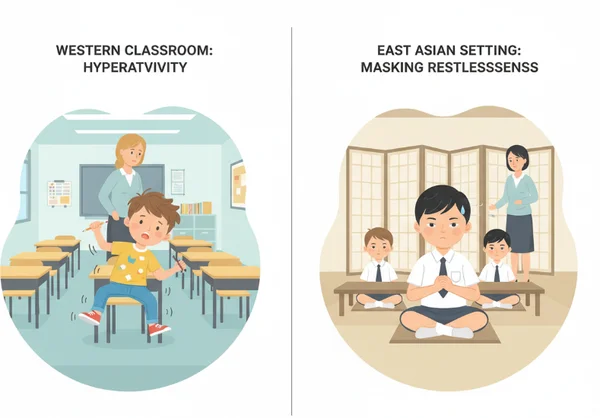
In many Western cultures, hyperactivity is identified when a child cannot sit still. For adults, it often feels like a constant "inner restlessness." The threshold for what is considered "too much" movement varies significantly. In cultures that value high energy and physical labor, a hyperactive individual might be seen as a hard worker with great vitality.
In contrast, cultures that emphasize quietness and stoicism may label minor fidgeting as a major problem. In some East Asian contexts, social pressure to maintain "harmony" and "composure" makes hyperactive symptoms stand out sharply. Case studies show that children in these environments often "mask" their hyperactivity to avoid social shame. This leads to internal exhaustion rather than outward disruption.
Cultural Variations in Inattentiveness and Impulsivity
Inattentiveness is the "quiet" side of ADHD, but its recognition depends on cultural values regarding focus. In highly individualistic societies, failing to focus on a personal task is seen as a failure of productivity. In collectivist societies, inattentiveness is noticed more when it affects the group. This might include forgetting a relative’s birthday or failing to follow group instructions.
Impulsivity also looks different across borders. In some cultures, speaking your mind quickly is seen as being "assertive" or "honest." In others, the same behavior is viewed as a lack of respect for authority. Gender plays a massive role here as well. Impulsive boys might be excused with the phrase "boys will be boys." Meanwhile, impulsive girls are often judged much more harshly for the same behaviors.
The Impact of Cultural Values on ADHD Recognition
Our cultural values act as a lens through which we view mental health. Collectivist cultures highly value family reputation. Here, admitting to ADHD may feel like "losing face." This stigma prevents many from seeking an online ADHD test or professional help until symptoms become impossible to ignore.
Conversely, individualistic cultures might focus so much on "self-optimization" that they over-pathologize normal human variations. The goal is to find a balance. We must recognize that ADHD is a real neurobiological condition while acknowledging that our environment dictates how we report our challenges.
Challenges of Standardized ADHD Assessments in Diverse Populations
Most screening tools used today were developed using data from North America or Western Europe. While these tools are scientifically rigorous, they can miss the mark for people from different linguistic or cultural backgrounds. Our protocols at this platform are developed using DSM-5 criteria alongside input from multilingual clinicians to ensure accuracy across these divides.
Language and Translation Considerations
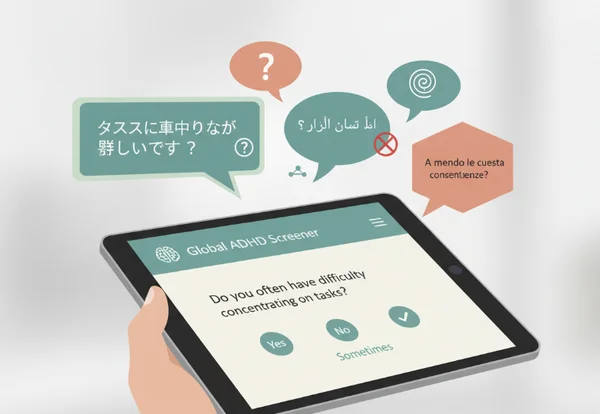
Language carries more than just literal definitions; it carries meaning. Many ADHD screening tools use idioms that do not translate well. For instance, asking if you feel "driven by a motor" makes sense in a mechanized society. However, it may be confusing in a culture where such metaphors are uncommon.
Direct translations often lose the emotional weight of a symptom. If a translated questionnaire asks about "restlessness," but the local language only has a word for "anxiety," the user may provide an inaccurate answer. This is why having access to multilingual assessments that are culturally adapted—rather than just translated—is vital for accuracy.
Cultural Bias in Assessment Tools
Standardized scales, such as the Vanderbilt or ASRS, lean toward Western ways of expressing distress. If an assessment focuses heavily on academic performance in a specific school system, it may fail to identify ADHD in someone from a different educational background.
The risk of this bias is either underdiagnosis or misdiagnosis. In Western countries, minority groups are sometimes misdiagnosed with conduct disorders because their hyperactivity is viewed through a lens of prejudice. Conversely, others never receive help because their quiet inattentiveness is culturally labeled as "shyness."
Cultural Differences in Help-Seeking Behaviors
How a family approaches a doctor is often a cultural decision. In some communities, the family is the only place to seek help for behavioral issues. There may also be a deep-seated mistrust of medical institutions due to past systemic biases. If your child’s energy feels mismatched with classroom expectations, you might hesitate to seek a formal label due to these external pressures.
When people do seek help, they may use "somatic" descriptions. Instead of saying "I can't focus," they might report frequent headaches or chronic fatigue. An assessor who lacks cultural competence might treat the physical symptom but miss the underlying ADHD. This is why a private, low-pressure assessment tool serves as a helpful bridge for those hesitant to visit a clinic immediately.
Toward Culturally Sensitive ADHD Assessment
The field of psychology is moving toward "culturally sensitive" models. This means looking at the whole person, including their language, heritage, and social environment.
Adaptations for Cultural Sensitivity
Modern assessments now incorporate questions that account for cultural context. This involves asking how symptoms affect specific cultural roles. Interpretation is just as important as the questions themselves. A score that indicates ADHD in one culture might mean something slightly different in another. By using diverse data sets, researchers are creating scales that are fair to everyone, regardless of their location.
The Role of Cultural Brokers in Assessment
A "cultural broker" acts as a bridge between a patient’s heritage and the medical system. This could be a community leader or a culturally competent therapist. These brokers help explain the "why" behind certain behaviors. This ensures a clinician does not misinterpret a cultural norm as a psychiatric symptom. Training for assessors now emphasizes "cultural humility," where professionals learn directly from the patient's lived experience.
Technology and Cultural Accessibility in ADHD Assessment
Technology boosts accessibility through multilingual tools. Taking a test in your preferred language reduces mental effort—helping you respond more authentically. Digital platforms allow users to engage with tools in the language they find most comfortable, which leads to more honest and accurate results.
Artificial Intelligence is also being used to provide nuanced interpretations. At adhdassessment.me, AI-driven reports analyze patterns that go beyond a simple "yes" or "no" score. This technology helps bridge the gap by providing personalized insights that consider unique linguistic preferences and user input.
The Importance of Cultural Considerations in Your ADHD Journey
Understanding your cultural lens is a vital part of your growth. Before you take an assessment, reflect on your upbringing. Did your parents value quietness above all else? Was "multitasking" a requirement for success in your community? Awareness of these influences helps you answer screening questions more accurately.
Instead of thinking, "I am a bad student," you might realize you struggled in an environment that didn't allow for the movement your culture discouraged. This shift in perspective is crucial for providing honest data during an online ADHD assessment.
Finding Culturally Competent Assessment Resources
When looking for professional help, ask direct questions. You can ask a psychologist about their experience with your cultural background. You should also ask how they account for cultural differences in their diagnosis. For more information on the clinical side of this journey, you can read about How ADHD Assessments Work.
Seek resources offering multilingual support and strict privacy. Your assessment report should empower conversations with professionals. Starting with an online tool provides a clear report to bring to a clinician, making the conversation easier to start. If you are ready to begin, you can start your test today to get a clearer picture of your symptoms.
Beyond Assessment: Culturally Tailored Support Strategies
Once you have your results, your support should fit your culture. A productivity strategy for a corporate worker in London might not work for a parent in a large, multi-generational household in Mumbai. Effective support involves adapting strategies like "time-blocking" to fit your specific lifestyle. The goal is to make your life easier within the world you actually live in.
Your Culturally Informed Path to ADHD Understanding
Your cultural background shapes how ADHD shows up—and how you can thrive with it. Symptoms like hyperactivity and inattention are universal, but their "flavor" changes depending on where we come from. Standardized tests are powerful, but they work best when we account for language, bias, and different help-seeking behaviors.
By choosing a multilingual assessment, you ensure that your first step toward clarity is accurate. An assessment is a tool to help you move forward. Whether you are a parent or an adult looking for answers, understanding the cultural context of your mind is a necessary step. Begin mapping your unique patterns today.
Ready to gain personalized insights into your attention and focus? Take the test today and start your journey toward a clearer version of yourself.
The Takeaway
Can ADHD symptoms be different in different cultures?
Yes. While the biological basis of ADHD is the same globally, the way symptoms are expressed and perceived varies. For example, what is seen as "impulsivity" in one culture might be viewed as "boldness" in another. Understanding these differences helps in getting a more accurate online assessment.
How does cultural background affect ADHD diagnosis?
Cultural background affects how parents, teachers, and individuals report symptoms. If a culture has high stigma regarding mental health, symptoms may be described as physical ailments instead. This can lead to delays in seeking help through an ADHD screening tool.
Are ADHD assessment tools culturally biased?
Many traditional tools were developed based on Western populations, which can lead to bias. Forward-thinking platforms now adapt tests using real-world feedback from global users—like you—to eliminate bias. Take a step toward clarity with our culturally adapted ADHD assessment.
How important is it to have a culturally competent assessor?
It is essential. A culturally competent assessor understands that your behavior is influenced by your upbringing and environment. They are less likely to misinterpret cultural norms as psychiatric symptoms, leading to a more trustworthy diagnosis and treatment plan.
Can an online assessment account for cultural differences?
Yes. Advanced online platforms use multilingual support and AI-driven personalized reports to provide deeper insights. By allowing you to start the assessment in your native language and offering nuanced analysis, these tools bridge many cultural gaps found in traditional paper tests.
Disclaimer: This article is for informational purposes only and does not replace professional medical advice, diagnosis, or treatment. Always seek the advice of your physician or another qualified health provider with any questions you may have regarding a medical condition.