ADHD Masking in High-Achievers: How Online Assessments Reveal Hidden Struggles
Do you feel like you're constantly running on a treadmill—achieving success on the outside but feeling exhausted and overwhelmed on the inside? Many high-achieving adults—successful professionals, dedicated students, and organized parents—secretly struggle with focus, organization, and a persistent feeling of being an imposter. This hidden battle could be a sign of ADHD, often concealed by years of developing clever coping strategies.
This phenomenon is known as ADHD masking. While it helps you succeed, it comes at a great cost to your mental energy and well-being. This article will explore what ADHD masking is, how high-achievers use it, and why traditional tests sometimes fail to see past the mask.
Most importantly, you'll learn how modern, AI-enhanced tools can help uncover these hidden patterns. If you're ready to understand the full picture of your attention and focus, a reliable online ADHD assessment can be a powerful first step toward clarity.

Understanding ADHD Masking in High-Achievers
Many people picture ADHD as visible hyperactivity or obvious inattention. However, for countless adults—particularly those successful in careers or academics—the reality is much more subtle. They have learned to hide, or "mask," their core challenges so effectively that even they may not recognize them as symptoms of ADHD. Understanding this concept is key to validating your struggles and finding the right support.
What is ADHD Masking and Who Does It?
ADHD masking is the unconscious or conscious effort to hide symptoms of ADHD to fit in socially or meet external expectations. People who mask may force themselves to maintain eye contact, suppress fidgeting, or rehearse conversations in their head. They work extra hard to appear organized, punctual, and attentive, even when their brain is pulling them in a thousand different directions.
This is especially common in adults who were not diagnosed as children. It's also frequently seen in women, who often present with less disruptive, more internalized symptoms. High-achievers, by definition, have developed powerful compensatory systems that can make their underlying ADHD nearly invisible to others and even to themselves.
The High-Achiever Profile: External Success, Internal Challenges
On the surface, the high-achiever with masked ADHD looks like the epitome of success. They might be the star employee who never misses a deadline, the straight-A student, or the parent who juggles everything flawlessly. But beneath this polished exterior lies a different story.
This success is often fueled by intense anxiety, a fear of failure, and chronic self-doubt. They might spend twice as long as their peers on a task, stay up all night to perfect a presentation, or experience extreme mental fatigue after social events. The constant effort to maintain control and performance leads to burnout, anxiety, and a feeling that they are just one mistake away from it all falling apart. You're not broken—you've developed sophisticated strategies to manage your brain's wiring.
Common Compensatory Strategies of High-Achievers with ADHD
The success of high-achievers with ADHD isn't accidental. It's built on a foundation of sophisticated, and often exhausting, compensatory strategies. These behaviors are developed over years to manage the underlying challenges of inattention, impulsivity, and executive dysfunction. While effective, they are the very things that mask the core issues.
Hyperfocus and Intense Preparation
One of the most powerful tools in the high-achiever's arsenal is hyperfocus. This is an intense, prolonged state of concentration on a single, interesting task, where the rest of the world seems to fade away. When aimed at a work project or academic paper, hyperfocus can produce brilliant results. You might pull an all-nighter, fueled by passion and pressure, delivering work that amazes your colleagues.
However, this isn't a superpower you can control. It often comes at the expense of other important life areas, like eating, sleeping, or attending to family. The intense preparation is often a response to a deep-seated fear of being "found out" or appearing unprepared, driving you to over-prepare for every meeting and presentation.
Overcompensation and Perfectionism
Perfectionism is another hallmark of the high-achieving individual with ADHD. To avoid making careless mistakes—a common ADHD trait—they might develop rigid systems, checklists, and routines. They may re-read emails ten times before sending them or spend hours on minor details that others overlook. This isn't about a healthy desire for quality; it's a defense mechanism against the brain's natural tendency toward disorganization.
This overcompensation is mentally draining. It creates a constant pressure to be flawless, because they believe any small error will reveal their perceived incompetence. This cycle of perfectionism and anxiety is a major contributor to burnout and can make it difficult to ever feel truly satisfied with their accomplishments. If this sounds familiar, a preliminary ADHD self assessment could provide valuable insights.
Limitations of Traditional ADHD Assessments for High-Achievers
If you're a high-achiever who has long suspected ADHD, you may have even sought an assessment in the past, only to be told you don't fit the criteria. This can be an incredibly invalidating experience. The issue typically isn't with you—it's with standard assessment methods. These tests were designed to identify ADHD symptoms in children and adolescents, not in high-functioning adults who have developed sophisticated compensation strategies over time.
Why Standard Tests May Miss Subtle Symptoms
Many traditional ADHD questionnaires rely on straightforward, black-and-white questions about observable behaviors. For example, a question might be, "Do you often lose things necessary for tasks or activities?" A high-achieving adult may honestly answer "no." This isn't because they lack the tendency, but because they have developed three different backup systems to prevent it from happening.
Their success at compensating for a symptom is misinterpreted as the absence of the symptom itself. The standard test fails to measure the enormous effort and anxiety required to achieve that "no." It sees the successful outcome, not the hidden struggle behind it.
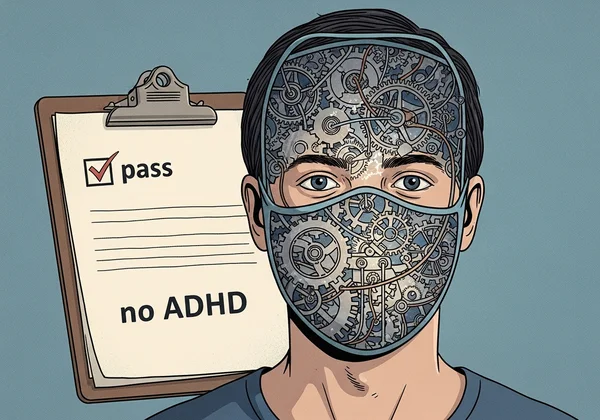
The Challenge of Self-Reporting When Symptoms Are Masked
Effective masking can be so deeply ingrained that you may no longer recognize your coping mechanisms as separate from your personality. You might think, "I'm not disorganized; I'm just a very diligent planner." Or, "I'm not inattentive; I'm just a perfectionist."
When filling out a self-report questionnaire, you may downplay your struggles because you've normalized them as part of your "hard-working" identity. This makes it incredibly difficult to provide answers that reflect the true extent of your ADHD-related challenges. The mask has become so convincing that it fools not only others but also yourself. This makes an accurate self-assessment difficult without a more nuanced tool. Recognizing this is a crucial first step, and an online ADHD assessment designed for adults can help you start to see these patterns.
How AI-Enhanced Assessments Uncover Hidden ADHD Patterns
This is where technology can make a significant difference. Modern, AI-enhanced assessments do more than ask simple questions. They look for subtle patterns that reveal masked ADHD. These tools aim to understand the 'how' and 'why' behind your answers, not just the answers themselves. At Adhdassessment.me, we leverage this technology to offer a more insightful screening experience.
Beyond Yes/No Questions: Analyzing Response Patterns
Unlike a static checklist, an AI-driven assessment can analyze nuances in how you respond. It can identify patterns of inconsistency, where you might report high functioning in one area (e.g., work organization) but significant challenges in another (e.g., managing personal finances). The AI is designed to look for the signature of compensation.
It recognizes that a combination of "intense perfectionism" and "high anxiety about deadlines" is a strong indicator of a compensatory strategy for underlying executive function challenges. By analyzing a web of interconnected responses, it builds a more holistic picture that honors the complexity of your experience, providing insights that a standard screener might miss.

Real-World Case Studies: How Masking Was Revealed
Consider the example of a successful lawyer who took our assessment. On paper, she was thriving. But her results showed extreme scores in perfectionism and time-related anxiety, alongside subtle indicators of inattention. The AI-powered report highlighted that her long work hours were likely a compensation for difficulty sustaining focus—a pattern she had never connected to ADHD. Seeing this laid out clearly was her "aha!" moment.
Another case involved a software developer who always delivered excellent code but struggled with team collaboration. His assessment revealed patterns consistent with hyperfocus and difficulty with task-switching. The personalized insights helped him understand why he found open-plan offices so draining and gave him the language to discuss his needs with his manager. For many, taking the first step with an online assessment provides the clarity needed to move forward.
From Masked Struggles to Clarity: Your Next Steps
Being a high-achiever with ADHD can feel like a contradiction. You're successful, yet you struggle. You are competent, yet you feel like an imposter. This article has shown that this experience is not a contradiction but a common and valid reality known as ADHD masking.
Through reading this, you may now recognize how your intense preparation, perfectionism, and hyperfocus have served as powerful coping mechanisms for your ADHD traits. You also now understand why traditional assessments might miss these subtleties, focusing only on your successful outcomes rather than the immense effort required to achieve them.
Remember, you're not alone—there are tools that can help you see past the mask. This clarity isn't about finding a label. It's about validating your experience, understanding your unique brain, and finding sustainable ways to thrive without constantly fearing burnout.
Are you ready to discover what lies beneath your success? Take the next step toward self-understanding. Start your ADHD assessment today and get the personalized insights you deserve.
Frequently Asked Questions About ADHD Masking and Assessment
-
Can high-functioning adults still have ADHD even if they're successful?
Absolutely. Success does not rule out ADHD. Many high-functioning or "successful" adults have developed extraordinary coping mechanisms to manage their symptoms. However, this success often comes at a high personal cost, such as chronic stress, anxiety, and burnout. An assessment can help clarify if these struggles are linked to ADHD. -
How does ADHD masking affect mental health and career longevity?
Constantly hiding your true self and compensating for challenges is mentally exhausting. Over time, ADHD masking can lead to severe anxiety, depression, impostor syndrome, and burnout. It can impact career longevity because the energy required to maintain the "mask" becomes unsustainable, leading to career changes or plateaus. -
What makes online ADHD assessments different for detecting masked symptoms?
Advanced online assessments, especially those using AI, are designed to look beyond surface-level answers. They analyze patterns across multiple domains of your life to identify compensatory behaviors. For instance, they can correlate high levels of perfectionism with challenges in starting tasks, which may point to masked ADHD. To see how this works, you can try our assessment. -
What are the signs that my success strategies might actually be compensating for ADHD?
Signs include chronic procrastination followed by intense bursts of last-minute work (hyperfocus), extreme perfectionism to avoid mistakes, high anxiety around deadlines and meetings, needing more time than peers to complete tasks, and feeling exhausted after "normal" social or work activities. -
Once I identify masking through an assessment, what are the next steps for a high-achiever?
The assessment report is a valuable tool for self-awareness and a starting point for a conversation with a qualified healthcare professional. They can provide a formal diagnosis and discuss strategies, therapies, or coaching tailored to high-achievers. The goal is to learn how to work with your brain, not against it, to achieve success more sustainably.
Disclaimer: This article is for informational purposes only and does not constitute medical advice. The online screening tool on Adhdassessment.me is not a diagnostic test. Please consult with a qualified healthcare professional for a formal diagnosis and treatment plan.