Understanding Your ADHD Assessment Results: A Complete Guide for Adults
The moment you finish an ADHD assessment, a flood of questions often follows. You might look at a page full of numbers, graphs, or checkmarks and wonder: "What do these scores actually mean for my life?" It’s common to feel a mix of relief and confusion. You may finally have words for your experiences, but you might also feel overwhelmed by the technical language used in the report.
This guide is designed to demystify the assessment process. We will translate complex scores into practical insights about your attention patterns, your hidden strengths, and your specific areas for growth. Whether you have just completed an online screening or a formal clinical evaluation, understanding your results is the first step toward clarity. By the end of this article, you will know how to turn those numbers into an actionable plan for a better daily life.

What Do ADHD Assessment Scores Actually Measure?
An ADHD assessment doesn't measure your intelligence or self-worth. Instead, it examines how your brain processes information and manages tasks compared to established scientific norms. Most assessments, including those used for an ADHD assessment, are based on the Diagnostic and Statistical Manual of Mental Disorders (DSM-5) criteria.
Beyond the Numbers: Understanding Core ADHD Dimensions
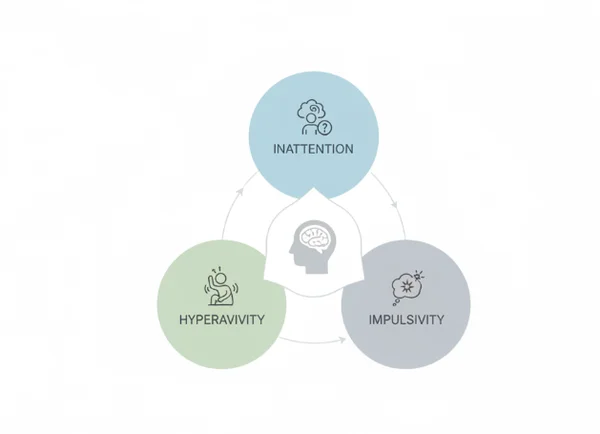
ADHD is not a "one size fits all" condition. Assessments typically measure three core dimensions: inattention, hyperactivity, and impulsivity.
- Inattention: This measures how difficult it is for you to stay focused on repetitive tasks, follow multi-step instructions, or organize your physical space.
- Hyperactivity: This looks at physical or mental restlessness. For adults, this often feels like an "internal motor" that won't stop running.
- Impulsivity: This measures how often you act or speak before thinking. It also tracks how much you struggle with waiting your turn.
By looking at these dimensions, an assessment helps identify which "type" of ADHD traits are most prominent in your life. Some people score high in inattention but low in hyperactivity, while others experience a combination of both.
How Different Assessment Tools Measure ADHD Differently
Not all tests are the same. A parent might use the Vanderbilt Assessment Scales to track a child’s behavior at school and home. An adult might use the Adult ADHD Self-Report Scale (ASRS). This tool focuses on workplace productivity and social consistency.
Some tools are "observer-based," meaning a doctor or teacher fills them out. Others are "self-report" tools where you share your own lived experience. The most effective approach often involves using a validated online ADHD assessment to gather initial data. You can then share this information with a professional to provide a complete picture of your mental health.
Interpreting Your ADHD Assessment Results: A Step-by-Step Guide
To understand your results, you'll need to look at both your raw scores and how they're scaled on the assessment. If you used a digital tool, you likely received a summary that categorizes your traits. Understanding the mechanics of these scores helps you advocate for yourself during medical appointments.
Decoding Your Raw Scores and Percentiles
A raw score is simply the sum of your answers. For example, if a test has 18 questions and you answer "often" to 15 of them, your raw score is high. However, raw scores don't tell the whole story.
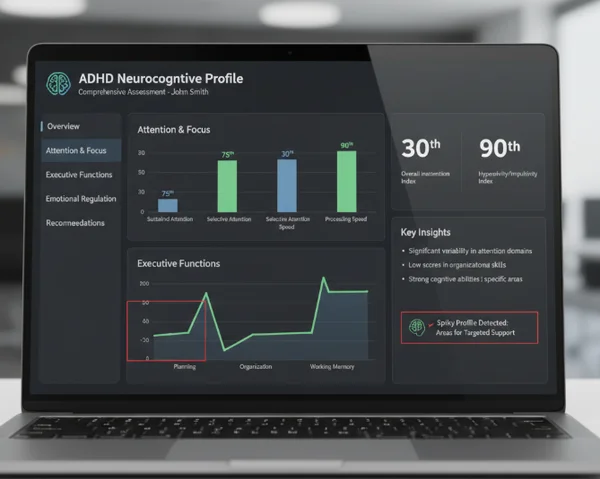
Percentiles are often more helpful. If your report says you are in the "90th percentile" for inattention, it means your challenges with focus are more frequent or intense than 90% of the general population. High percentiles in specific areas usually indicate that those symptoms are significantly impacting your ability to function.
Pattern Recognition: What Your Score Distribution Reveals
Do not just look at the total score. Look at where the "peaks" are. You might find that you score very high on "organization" challenges but very low on "interrupting others." This distribution creates a "symptom profile."
A "spiky" profile is very common in ADHD. This happens when you excel in some areas but struggle deeply in others. Recognizing these patterns helps you stop saying "I'm bad at everything." Instead, you can start saying "I am great at brainstorming, but I need a system for my calendar." To see your own patterns, you can start the test today and review your personalized report.
Connecting Scores to Real-World Challenges and Strengths
The goal of interpreting results is to bridge the gap between a number on a page and your Monday morning. If you have a high score in "Task Initiation," that explains why you sit at your desk for two hours before actually starting a project.
It is also important to look for strengths. Many people with ADHD traits score high in areas like "Hyperfocus" or "Creative Problem Solving." Your results should help you identify not just what is "wrong," but also how your brain works best.
What Your ADHD Assessment Results Mean for Daily Life
Once you understand the scores, you can look at how they manifest in your home, work, and relationships. ADHD involves more than just trouble paying attention—it's about how your brain manages tasks, time, and emotions.
Understanding Your Attention and Focus Patterns
Your results might show that you don't lack attention, but rather that you struggle to direct it. This is often called "interest-based" nervous system functioning. If your results indicate high inattention, it means your brain likely requires high levels of stimulation, urgency, or novelty to engage with a task. Understanding this allows you to stop using "willpower" and start using "strategies" like timers or body-doubling.
Identifying Executive Function Strengths and Challenges
Executive functions are the "CEO" of the brain. They handle working memory, time management, and emotional control. An assessment often reveals which part of the CEO's office is struggling.
- Working Memory: Do you forget why you walked into a room?
- Time Blindness: Do you consistently underestimate how long a task takes?
- Organization: Is your digital or physical space always in chaos?
Identifying these specific gaps allows you to find a detailed report that suggests specific tools. You can then look for digital planners or specialized apps to support your specific executive function needs.
How Results Relate to Emotional Regulation and Impulse Control
Many people are surprised to find that "emotional dysregulation" is linked to their ADHD scores. If you score high in impulsivity, you might also experience "rejection sensitive dysphoria" or quick shifts in mood. Your brain’s inability to "filter" external distractions also applies to internal emotions. Recognizing this through your assessment can be life-changing. It helps you realize that your intense emotions are a biological trait, not a character flaw.
Next Steps After Understanding Your ADHD Assessment Results
Receiving your results is a major milestone, but it is not the finish line. It is the foundation for the next phase of your journey toward self-improvement and clarity.
When to Consider Professional Evaluation
It is vital to remember that an online screening is a "first look," not a formal medical diagnosis. If your results show significant ADHD traits, the next step is to take your report to a healthcare professional. You should speak with a psychiatrist or a specialized psychologist.
A healthcare professional will use your screening results as a starting point. They'll also review your medical history and check for other conditions that might mimic ADHD symptoms, such as anxiety or thyroid issues. Having a clear report from a reliable tool makes this conversation much easier and more productive.
How to Use Your Assessment Results to Build a Support Plan
You don't need a formal diagnosis to start improving your life. Use your results to build a "scaffolding" of support.
- Workplace Accommodations: If you struggle with noise distraction, ask for noise-canceling headphones.
- Home Systems: If "object permanence" is a struggle, use clear bins for storage so you can see your belongings.
- Communication: Share your results with a partner to explain why you might struggle with listening during long conversations.
Tracking Progress and Reassessing Over Time
ADHD symptoms are not static. They can change based on your stress levels, your environment, and your age. It is a good idea to use the tool every few months to see if your strategies are working. If your scores in "Emotional Regulation" improve after starting meditation or therapy, you know you are on the right track.
Your ADHD Assessment Results Are Just the Beginning
Understanding your results is a powerful act of self-care. It moves you away from self-criticism and toward self-understanding. By decoding your scores, recognizing your patterns, and connecting those findings to your daily habits, you gain a roadmap for your future.
Remember, these results do not define your limits; they simply highlight where you might need a different bridge to reach your goals. Whether you are a parent looking for answers for your child or an adult seeking to reclaim your productivity, the journey starts with data. If you haven't yet taken that first step, you can get your assessment now to begin your path toward clarity and confidence.
Frequently Asked Questions
What do the different ranges in ADHD assessment scores mean?
Most assessments use ranges like "Minimal," "Mild," "Moderate," or "Severe." These ranges indicate how frequently your symptoms occur and how much they interfere with your daily life. A "Severe" score suggests that ADHD traits are significantly impacting your work or relationships. In this case, seeking professional help should be a priority.
Can I self-diagnose ADHD based on my assessment results?
While an assessment provides deep insights, it is a screening tool, not a formal diagnosis. Self-assessment is an excellent way to validate your feelings and gather evidence. However, a formal diagnosis requires a clinical interview with a licensed professional. You can use your assessment results as a factual base for that discussion.
How should I discuss my assessment results with my healthcare provider?
Print out your summary or report and highlight the areas that resonate most with your daily struggles. Be specific. Instead of saying "I can't focus," say "My assessment shows I am in the 95th percentile for inattention. This shows up as being unable to finish reports at work."
Are my assessment results permanent, or can they change over time?
ADHD is a neurodevelopmental condition, meaning the underlying brain structure remains. However, the expression of symptoms can change. With the right environment, habits, or treatment, your scores on a screening tool can certainly improve as you learn to manage your challenges more effectively.
What's the difference between screening assessment results and a formal ADHD diagnosis?
A screening tool identifies the presence of ADHD traits and symptoms. A formal diagnosis involves a doctor looking at the cause of those symptoms. They ensure symptoms began in childhood and confirm they aren't caused by something else. A screening is the fastest first step to determine if a full clinical evaluation is necessary.
Disclaimer: This article is for informational purposes only and is not a substitute for professional medical advice, diagnosis, or treatment. Always seek the advice of your physician or other qualified health provider with any questions you may have regarding a medical condition.