What Does ADHD Mean in Simple Terms
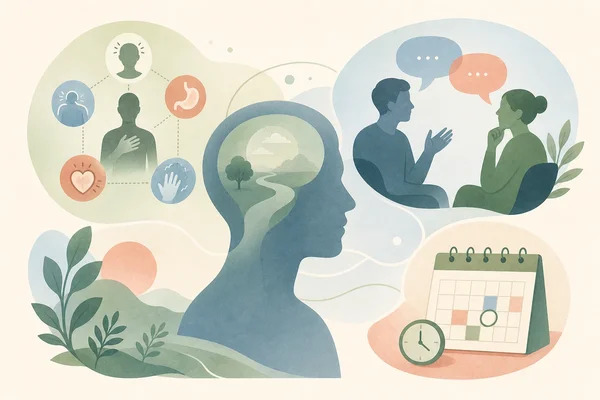
What does ADHD mean? In simple terms, ADHD means attention-deficit/hyperactivity disorder, a developmental condition linked with ongoing patterns of inattention, hyperactivity, impulsivity, or a mix of these traits. It does not mean someone is lazy, careless, badly behaved, or unable to succeed. It means their attention, energy, self-control, timing, organization, or emotional regulation may work differently enough to affect school, work, relationships, or everyday routines. If you are trying to understand your own patterns before talking with a professional, a private ADHD screening first step can help you organize observations without replacing professional guidance.
What ADHD Stands For
ADHD stands for attention-deficit/hyperactivity disorder. The name can sound harsher than the lived experience because "deficit" does not mean a total lack of attention. Many people with ADHD can focus deeply on something interesting, urgent, novel, or emotionally engaging. The challenge is often regulating attention: choosing where it goes, shifting it when needed, sustaining it through less rewarding tasks, and stopping distractions from taking over.
The "hyperactivity" part can also be misunderstood. In a young child, it may look like running, climbing, fidgeting, talking a lot, or struggling to stay seated. In an adult, it may feel more internal: restlessness, mental speed, impatience, needing to multitask, or feeling uncomfortable with stillness. Impulsivity can show up as interrupting, quick spending, blurting out answers, risky decisions, or reacting before there is time to pause.
So when someone asks "what does ADHD mean in medical terms," the plain answer is that it refers to a pattern of attention and self-regulation symptoms that begins in childhood and can continue into teen and adult life. A formal ADHD diagnosis is based on a fuller clinical evaluation, not a single online score or one busy week.
What ADHD Can Do in Daily Life
ADHD can affect a person by making ordinary tasks require more effort than other people can see. Someone may understand exactly what needs to be done, care deeply about doing it, and still struggle to begin, prioritize, estimate time, or finish. That gap between intention and action is one reason ADHD can feel confusing from the outside.
In daily life, ADHD may affect:
- Time awareness, such as running late or underestimating how long a task will take.
- Task initiation, such as feeling stuck even when the task matters.
- Working memory, such as forgetting why you entered a room or losing track of steps.
- Organization, such as piles, missed forms, late bills, or scattered digital notes.
- Emotional regulation, such as frustration rising quickly or rejection feeling intense.
- Follow-through, such as starting many things and finishing fewer of them.
This does not mean ADHD looks the same in everyone. One person may appear restless and loud. Another may look quiet, dreamy, and overwhelmed. A third may seem high-achieving but pay for it with exhaustion, late nights, masking, and constant overcompensation.

Common ADHD Symptoms in Plain English
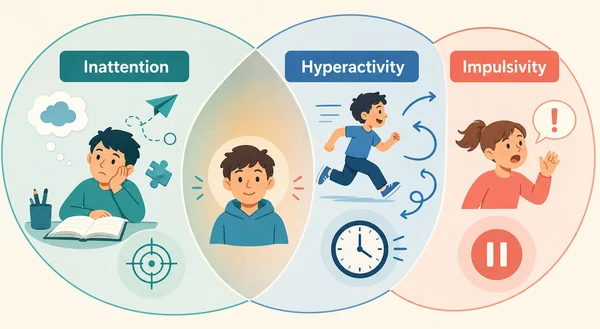
The most common ADHD symptoms are usually grouped into inattention, hyperactivity, and impulsivity. If you are using a structured ADHD trait check, it helps to think in examples rather than labels.
Inattention can mean frequent trouble staying with details, listening through a conversation, finishing tasks, organizing materials, managing deadlines, remembering daily responsibilities, or resisting distraction. It may look like "not trying," but the inner experience is often effortful and frustrating.
Hyperactivity can mean moving, fidgeting, talking, feeling driven by motion, or finding quiet activities uncomfortable. For teens and adults, it can become less visible and more like inner restlessness, mental buzzing, or a constant need to do something.
Impulsivity can mean acting before thinking, interrupting, difficulty waiting, quick emotional reactions, or trouble slowing down a decision. Impulsivity is not always dramatic. It can be as small as sending a message too quickly, changing tasks too often, or agreeing to a plan before checking time and energy.
Many people also talk about ADHD-related experiences that are not the headline symptom categories: executive dysfunction, masking, overstimulation, stimming, emotional sensitivity, or rejection sensitivity. These terms can describe real experiences, but they should be used as clues for reflection, not as proof of any condition.
ADHD Presentations: Inattentive, Hyperactive-Impulsive, and Combined
People often ask what inattentive ADHD, impulsive ADHD, or combined ADHD means. Current clinical language commonly describes ADHD by presentation.
Predominantly inattentive presentation means the main pattern is difficulty with attention, organization, follow-through, forgetfulness, and distractibility. This is sometimes what people mean when they say "ADD," although ADHD is the broader current term many professionals use.
Predominantly hyperactive-impulsive presentation means the main pattern is high movement, restlessness, excessive talking, impatience, interrupting, or acting quickly without enough pause.
Combined presentation, sometimes shortened as ADHD-C, means a person has meaningful patterns from both sides: inattention plus hyperactivity or impulsivity. Combined type ADHD does not mean "worse" automatically. It means the symptom pattern includes both clusters.
Severity words such as mild, moderate, severe, borderline, or high functioning can be tricky. They usually say more about impact, support needs, impairment, and context than about a person's value or potential. Someone who looks "high functioning" may still be spending enormous energy to keep life together.
What ADHD Can Mean for Kids, Girls, and Adults
What does ADHD mean for kids? For a child, ADHD may affect classroom behavior, homework, friendships, emotional outbursts, transitions, sleep routines, and family stress. A child may know the rule and still forget it in the moment. They may want friends and still interrupt, grab, or miss social cues. They may be bright and still lose papers, avoid long assignments, or melt down after holding it together all day.
For girls, ADHD is sometimes missed because symptoms may be quieter or more internal. A girl may be chatty, daydreamy, anxious-looking, perfectionistic, emotionally intense, or very good at copying what others expect. Some girls and women mask their struggles by overpreparing, people-pleasing, or working late to hide disorganization. This does not mean ADHD is a "girl condition" or a "boy condition." It means presentation and expectations can affect who gets noticed.
For adults, ADHD can mean chronic difficulty with work systems, household routines, money management, appointments, parenting tasks, relationships, emotional regulation, or burnout. Some adults were never identified earlier because they were smart, quiet, supported by structure, or able to compensate until life became more complex.
The common thread is not one stereotype. It is a persistent pattern that creates friction across real-life settings.
ADHD Is Not the Same as Autism
Is ADHD a form of autism? No. ADHD and autism are different neurodevelopmental conditions, though they can overlap and some people have both. ADHD is centered more on attention regulation, activity level, impulsivity, and executive functioning. Autism is centered more on social communication differences, restricted or repetitive behaviors or interests, sensory patterns, and developmental differences.
The overlap is why confusion happens. A person with ADHD may miss social cues because their attention shifted. An autistic person may miss or interpret social cues differently because of social communication differences. A person with either condition may struggle with transitions, sensory overload, emotional regulation, or school and work demands. The outward moment can look similar while the underlying pattern differs.
This is also why a careful evaluation matters when ADHD, autism, anxiety, depression, sleep problems, trauma, or learning differences are all possible. The goal is not to force one label onto every struggle. The goal is to understand what kind of support would actually fit.
Use "What Does ADHD Mean" as a Starting Question
The question "what does ADHD mean" is a useful starting point because it moves the conversation away from blame and toward patterns. Instead of asking, "Why am I like this?" you can ask, "Where do attention, timing, emotion, or impulse control repeatedly create friction for me?"
Try writing down examples in three columns: what happens, where it happens, and what it costs. For example, "I miss deadlines at work," "I lose track during long meetings," or "my child melts down during homework transitions." Then note what helps even a little: timers, body doubling, movement breaks, visual checklists, shorter task blocks, sleep routines, or clearer instructions.
If the pattern is persistent, affects more than one setting, or is causing meaningful problems, it can be worth discussing with a qualified health or mental health professional. If you want a gentle way to sort your observations first, ADHD screening support for reflection can be a low-pressure bridge between vague concern and a more organized next step.

FAQ
What does ADHD stand for and what does it mean?
ADHD stands for attention-deficit/hyperactivity disorder. It means a person has an ongoing pattern of inattention, hyperactivity, impulsivity, or a combination that can affect everyday functioning. The name does not mean the person never pays attention or is always hyperactive.
What are 5 symptoms of ADHD?
Five common examples are distractibility, difficulty finishing tasks, poor time management, restlessness, and interrupting or acting too quickly. Other signs can include forgetfulness, disorganization, careless mistakes, emotional reactivity, and trouble waiting.
What does ADHD do to a person?
ADHD can make it harder to regulate attention, energy, impulses, time, emotions, and follow-through. It may affect school, work, home routines, relationships, money, driving, sleep habits, or self-esteem. The exact impact depends on the person, setting, supports, and coexisting concerns.
What does ADHD mean for kids?
For kids, ADHD can mean difficulty sitting still, following instructions, finishing schoolwork, managing emotions, waiting turns, keeping track of belongings, or moving smoothly between activities. Some children are very active and impulsive, while others are quiet and inattentive.
What is ADHD for a girl?
ADHD in girls can include the same core traits as ADHD in anyone, but it may be less obvious. Some girls show daydreaming, perfectionism, emotional sensitivity, disorganization, anxiety-like stress, or masking instead of obvious hyperactivity. A careful assessment looks beyond stereotypes.
Is ADHD bad?
ADHD is not a character flaw or a moral label. It can create real challenges, and those challenges deserve support. Many people with ADHD also have strengths such as creativity, energy, humor, persistence, curiosity, or fast idea generation, especially when their environment fits them better.
What does ADD and ADHD mean?
ADD is an older term many people still use for attention difficulties without obvious hyperactivity. Today, many professionals use ADHD as the broader term and describe presentations such as predominantly inattentive, predominantly hyperactive-impulsive, or combined.
Does an online ADHD test mean I have ADHD?
No. An online screen can help you notice traits, organize examples, and decide whether to seek professional guidance, but it is not a formal clinical conclusion. If symptoms are persistent, impairing, or confusing, a qualified professional can review history, context, and other possible explanations.